


Most coaches don’t have an ad problem. They have a recording problem.
The offer is good and the targeting is fine. But the video runs 90 seconds, is shot in a dark room, is framed too tight, and opens with “Hi everyone, my name is…” Nobody stops scrolling for that.
This guide shows the process we use at Cybersoft Digital to script, record and edit video ads for coaches and consultants. It covers two types of ads:
- Freebie ads (lead ads) that offer a free resource such as a masterclass, guide or checklist, to build your email list.
- Sales ads that sell a low-ticket product or program directly.
Freebie Ads vs. Sales Ads: What’s the Difference?
A quick note on terms. On Meta, “lead ads” usually means ads with an instant form inside Facebook. In this guide, “freebie ad” means a video ad that sends people to your own registration page. The scripting rules are the same either way.
| Freebie Ad | Sales Ad | |
|---|---|---|
| Goal | Get an email or registration | Get a purchase |
| Offer | Free (masterclass, guide, checklist) | Paid (course, toolkit, program) |
| Audience | Cold traffic | Cold, warm or retargeted |
| Ideal length | About 20 seconds | 30 to 45 seconds |
| Main job | Make them feel understood and curious | Reframe the problem and make the offer feel clear, safe and time-bound |
Both follow one idea: make the viewer feel understood before you ask for anything.
VIDEO 1: Freebie Ad Example
VIDEO 2: Sales Ad Example
Step 1: Write the Script Before You Press Record
Never improvise a Facebook ad. The first three seconds decide whether anyone watches the rest, so every line needs a job.
The Freebie Ad Framework (About 20 Seconds)
If you are a [audience] struggling with [problem], then you are not alone. Most people [remove the blame and explain why it’s happening]. That’s why I created [free gift name], which will help you [clear benefit and result].
Why it works:
- It calls out your audience. The right person recognizes themselves and stops.
- “You are not alone” lowers their guard. People are tired of being told they failed.
- It removes blame. The problem is explained as something outside their control, so they stay open to your solution.
- It offers one clear outcome. One freebie, one benefit.
The Sales Ad Framework (Longer, Built in Clips)
A sales ad needs more: a belief to challenge, a new explanation, credibility, what’s inside, and the offer. Here’s the structure:
- Challenge a common belief
- Say why that belief keeps people stuck
- Rename the problem
- Introduce the solution and your credibility
- Show what’s inside
- Give the offer, price and deadline, then tell them what to do next
Step 2: Hook Formulas for the First 3 Seconds
The hook is the first sentence. If it fails, the rest of your script doesn’t matter. Use these formulas and fill in your own niche.
- Challenge the common advice: “Everyone says the fix for [problem] is [common advice]. That’s exactly why it keeps happening.”
- Call out the audience: “If you’re a [role] who [specific situation], watch this.”
- Stop doing X: “Stop [common action] if you want [result].”
- The hidden reason: “Here’s what nobody tells you about [problem].”
- The number: “3 mistakes that keep [audience] stuck at [result].”
- The mistaken diagnosis: “You don’t have a [obvious problem] problem. You have a [real problem] problem.”
- The myth: “You don’t need [expensive thing] to [result].”
- The question: “Why does [frustrating thing] keep happening even when you [effort they’ve made]?”
- The quick win: “Here’s a 10-minute fix for [problem].”
- The cost of waiting: “Another [time period] of [problem] is the most expensive choice you can make.”
Examples from different niches:
- Business coach: “Posting every day and still no bookings? The problem isn’t your content.”
- Career coach: “Stop sending your resume to more jobs. Here’s what to fix first.”
- Leadership consultant: “Most new managers don’t fail because of skill. They fail in their first 30 days.”
- Course creator: “You don’t need 10,000 followers to launch a course.”
Write 5 hooks per ad. Record them all. They’re cheap to film and the best way to find a winner.
Step 3: Full Example Scripts
Daniel Reed and Priya Nair are fictional examples created for this guide.
Freebie Ad Example (20 Seconds)
Business coach Daniel Reed (fictional) offering “The 5-Call Booking Checklist.”
If you’re a coach who posts every week and still has an empty calendar, you’re not alone. Most coaches don’t have a content problem. They have a follow-up problem, because nobody told them what to say after someone shows interest. That’s why I created The 5-Call Booking Checklist, a free guide that shows you exactly what to say and send to turn more conversations into booked calls. Tap below and grab it.
Primary text for this ad (PAS format):
Posting more isn’t the fix. 📉
Most coaches lose bookings in the follow-up, not in the content. Interest shows up, and then silence.
The 5-Call Booking Checklist gives you the exact messages to send at each stage so interested people turn into booked calls. ✅
Tap below to download it free.
Headline: Free Booking Checklist for Coaches Button: Download
Sales Ad Example (40 Seconds, Clip by Clip)
Career coach Priya Nair (fictional) selling “The Offer Letter Playbook” for $67 in a New Year sale.
Clip 1 (Indoor) Everyone says the way to get a better job is to apply to more jobs. Fifty applications. A new resume template. A fresh start in January.
Clip 2 (Outdoor) But that’s exactly why so many job searches drag on for months.
Clip 3 (Indoor) Many professionals who apply everywhere and hear nothing back have a positioning problem, not an effort problem. The resume says what they did. It never says why it matters.
Clip 4 (Outdoor) That’s why career coach Priya Nair, who has helped professionals through hundreds of interviews, created The Offer Letter Playbook.
Clip 5 (Indoor) Inside are video lessons, resume and LinkedIn templates, and interview scripts that help you show your value clearly and handle the questions that decide offers.
Clip 6 (Outdoor) It’s 50% off for the New Year. Just $67, with lifetime access. Don’t let another quarter go by on the same applications. Tap below and start today.
Primary text (AIDA format):
Applying to more jobs isn’t the same as getting better results. 🎯
The Offer Letter Playbook shows you how to position your experience, rewrite your resume and LinkedIn, and answer the interview questions that matter.
Inside: video lessons, templates and scripts you can use today.
New Year price: $67 with lifetime access. 👇
Headline: Get the Offer Letter Playbook Button: Shop Now
Note: the numbers, discount and “hundreds of interviews” claim are placeholders for the example. Only use claims you can prove.
Why These Scripts Convert
- They open by challenging common advice. Disagreeing with what everyone has already tried creates curiosity.
- They rename the problem. “Not a content problem, a follow-up problem” gives the viewer a new way to see their struggle.
- They build authority in one sentence. Save the full biography for the landing page.
- They describe the product by what it does. Each item is tied to a result.
- The offer is specific and time-bound. Price, discount, access and a reason for urgency.
- They end with a clear instruction. “Tap below” leaves no doubt.
Tip: Alternate Indoor and Outdoor Clips
Changing the background every one or two sentences resets attention and makes a 40-second video feel faster. Film all indoor clips in one session and all outdoor clips in another.
Step 4: AI Prompts to Draft Your Scripts
Paste these into your AI tool and fill in the brackets.
Prompt 1: Freebie Ad Script
I need you to act as a Facebook video ad script expert and write a 20 second Facebook ad video script for this freebie:

[FREEBIE NAME + WHAT IT HELPS WITH]

Target audience:
[WHO EXACTLY]

Problem they are facing:
[PAINFUL SPECIFIC PROBLEM]

Main benefit or result:
[DESIRED OUTCOME]

Write in a fast talking, conversational tone.

Use this framework:
If you are a [call out the audience] struggling with [problem] then you are not alone. Most people [remove blame + explain why it's happening]. That's why I created [free gift name] that will help you [clear benefit and result].

Also provide primary text for this ad script with emojis (not much) in AIDA or PAS format which ever you think is the best. But not both.

And don't give me any kind of instruction. Just the output.
Prompt 2: Sales Ad Script
I need you to act as a Facebook video ad script expert and write a 30 to 45 second Facebook sales ad video script, split into 6 clips alternating between indoor and outdoor scenes, for this product:

[PRODUCT NAME + WHAT IT INCLUDES]

Price and offer:
[PRICE, DISCOUNT, DEADLINE, ACCESS]

Target audience:
[WHO EXACTLY]

Common advice they've already tried:
[COMMON ADVICE THAT DOESN'T WORK]

The real problem:
[NEW WAY TO SEE THE PROBLEM]

Creator credibility:
[ONE SENTENCE OF PROOF]

Write in a fast talking, conversational tone.

Use this structure:
Clip 1: challenge the common advice.
Clip 2: explain why it keeps people stuck.
Clip 3: rename the problem.
Clip 4: introduce the product and the creator's credibility.
Clip 5: describe what's inside and the result it creates.
Clip 6: price, discount, deadline, cost of waiting, and a clear instruction to tap below.

Do not make claims about the viewer's personal attributes, health, finances or guaranteed results.

Also provide primary text in AIDA or PAS format, whichever is best, but not both. Use a few emojis only.

Don't give me any instructions. Just the output.
How to fill them in well:
- Audience: Be specific. “Coaches who get inquiries but few booked calls” beats “coaches who want clients.”
- Problem: Use your clients’ words, not jargon.
- Result: Describe what changes in their life, not what’s inside the product.
Read the output out loud. If you stumble, rewrite it. If it doesn’t sound like you, it won’t feel real on camera.
Step 5: Primary Text, Headline and Button
The video gets attention. The text around it supports the click.
- Primary text (caption): Short problem, short promise, clear next step. Use AIDA (Attention, Interest, Desire, Action) or PAS (Problem, Agitate, Solution). Pick one per ad.
- Headline: Say what they get. “Free Booking Checklist for Coaches” works better than a clever line.
- Button: Match the offer. Freebie ads: Download or Sign Up. Sales ads: Shop Now or Learn More.
The text should support the video, not repeat it word for word.
Step 6: Frame Your Shot Correctly
This is where many coaches lose conversions without realizing it.
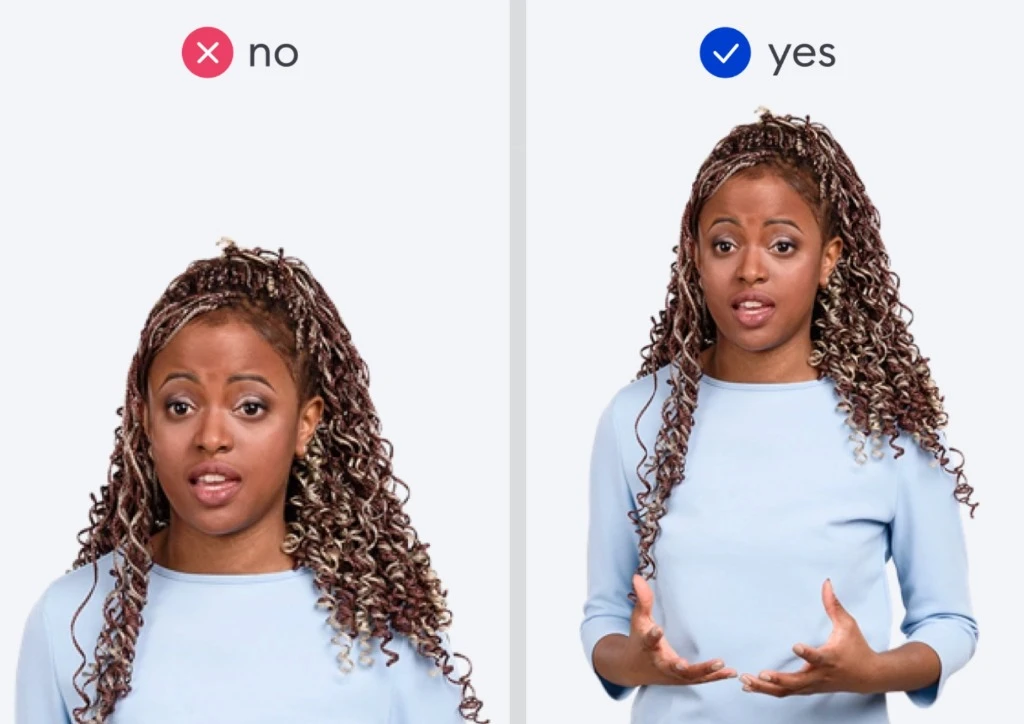
What not to do: The speaker sits low in the frame with a large empty space above the head. Hands are cut off, and the shot feels stiff and distant.
What to do: The shot runs from the head down to about the waist. Hands are visible and gesturing naturally, and the speaker feels like she’s talking to the viewer.
Framing rules:
- Shoot waist-up, not chest-up. You need room for your hands.
- Keep only a small gap above your head.
- Look at the lens, not at yourself on the screen.
- Shoot vertically (9:16). Most ad placements are mobile and vertical.
Leave Room for Facebook’s Interface
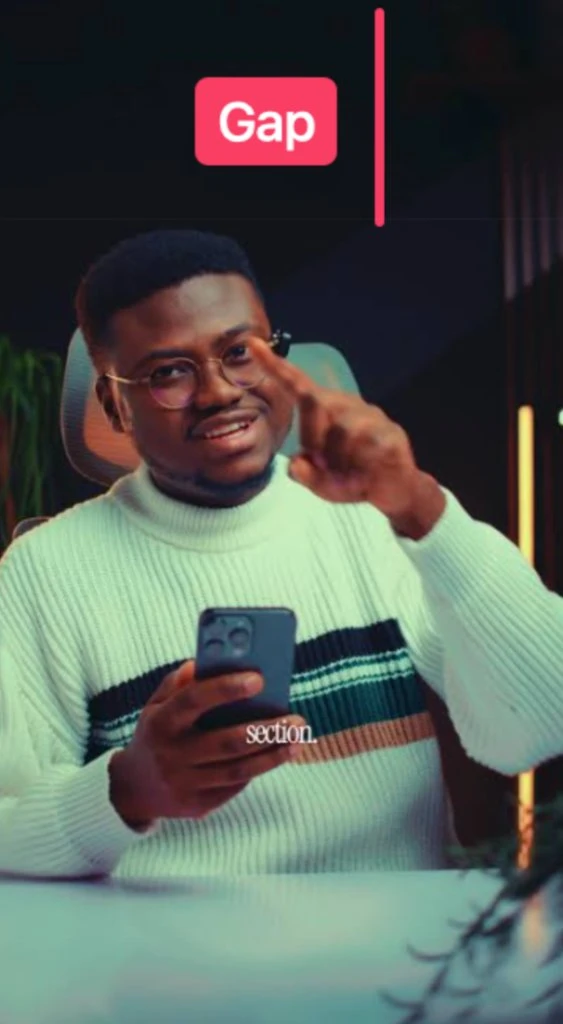
Facebook and Instagram place their own interface elements over your video: profile name, caption, buttons and the call-to-action bar. Anything important in those zones gets covered.
- Keep your face and key on-screen text in the middle of the frame.
- Place captions in the lower-middle area, above the bottom button zone.
- Meta’s guidance for Reels and Stories placements has been to keep roughly the top 14% and bottom 35% of the frame clear of important text, plus about 6% on each side. Check Meta’s current ad specs before finalizing, as these numbers change.
Step 7: Light, Sound and Background
Light. Face a window with soft daylight, or use a ring light or softbox in front of you. Don’t sit with a window behind you.
Sound. Bad audio kills ads faster than bad video. Use a clip-on lavalier mic or record in a quiet, carpeted room. Turn off fans and air conditioning.
Background. Keep it simple and on brand. A tidy desk or shelf works indoors. Outdoors, choose a shaded spot with even light, away from traffic.
Camera. Your phone’s rear camera is enough. Use 1080p or 4K at 30fps, clean the lens, and mount it on a tripod at eye level.
Step 8: Deliver and Edit for Attention
Delivery
- Talk fast, but not rushed. Cut pauses in editing.
- Record each clip separately: one or two sentences per take.
- Do three takes of every clip. The second or third is usually best.
- Smile at the start of the clip.
- Use your hands.
Editing
- Add captions. Most people watch with sound off. Highlight key words.
- Cut every pause and filler word.
- Add a cut every 3 to 5 seconds: a clip change, a zoom or a background change.
- Show the offer on screen when you say the price.
- Keep it tight. If a sentence doesn’t earn its place, cut it.
Tools to start with:
- CapCut: editing, auto-captions and vertical templates
- Canva: simple video edits, on-screen text and thumbnails
- Descript: edit video by editing the transcript, handy for removing filler words
- A free teleprompter app on your phone for reading scripts naturally
Step 9: Stay Within Meta’s Ad Policies
Ads get rejected or accounts get restricted for avoidable wording. Before you publish:
- Don’t imply you know personal traits. Lines like “Are you overweight?”, “Are you struggling with debt?” or “Do you suffer from anxiety?” can break Meta’s personal attributes rules. Talk about the situation or the general audience instead (“Many people who…”).
- Be careful in sensitive niches. Health, weight loss, mental health, finances and relationships get extra scrutiny.
- No before/after images or unrealistic results in health and weight categories.
- Don’t promise guaranteed outcomes. Say what the product helps with, not what it will definitely deliver.
- Make sure the landing page matches the ad and includes required policy pages.
Meta updates its rules often. Read the current Advertising Standards before every new campaign.
Step 10: Test and Measure
What to test, in this order:
- Hooks. Same offer, same body, 3 to 5 different first lines.
- Offer or angle. A different promise or problem.
- Format. Indoor vs. outdoor, with or without captions, length.
How to run the test:
- Put the variations in the same campaign so they compete under the same conditions.
- Give each ad enough time and spend to collect data. Don’t judge after one day.
- Change one thing at a time.
- Keep the winner and test new hooks against it.
Metrics to watch:
| Metric | What it tells you |
|---|---|
| Hook rate (3-second views ÷ impressions) | Whether the opening stops the scroll |
| Hold rate / average watch time | Whether the script keeps people watching |
| Link click-through rate (CTR) | Whether the offer and call to action are clear |
| Cost per lead / cost per purchase | Whether the ad makes money |
| Landing page conversion rate | Whether the page matches the ad |
Compare each metric to your own account’s averages, not to a number you saw online. If the hook rate is weak, fix the first 3 seconds. If people watch but don’t click, fix the offer or call to action. If they click but don’t convert, fix the page.
Step 11: Match the Ad to the Page
A great video can’t rescue a weak landing page.
- The headline on the page repeats the promise in the ad.
- Freebie ads go to a simple registration page with one action.
- Sales ads go to a checkout or sales page that confirms the price, discount and what’s included.
- Tracking is installed so you can see cost per lead or sale.
We build these funnels on GoHighLevel so registrations, calendar invites and follow-up emails run automatically. See our sales funnel service and GoHighLevel setup.
10 Common Mistakes to Avoid
- A long intro. Start with the hook, not your name.
- Tight framing. No hands, no energy.
- No captions. You lose everyone watching on mute.
- A script that sounds read. Practice until it sounds like talking.
- Several offers in one ad. One ad, one offer.
- Bad audio. Fix sound before anything else.
- Covering the interface zones. Text hidden behind buttons.
- Testing only one version. You can’t find a winner with one ad.
- Judging too early. Give each test enough data.
- Ad and landing page mismatch. Different promise, lost clicks.
Quick Checklist Before You Publish
- Script follows the framework and has been read aloud
- 3 to 5 hook variations recorded
- Shot is vertical, waist-up, with hands visible
- Face and captions sit clear of Facebook’s top and bottom zones
- Audio is clean
- Captions are burned in
- Offer, price and next step are clear
- Script checked against Meta’s current ad policies
- Landing page matches the ad promise
- Tracking is installed
Frequently asked questions
How long should a Facebook video ad be for coaches?
About 20 seconds for a freebie ad and 30 to 45 seconds for a sales ad.
Do I need to be on camera?
Not always, but ads with the coach on camera usually build more trust, especially when people buy you first.
Should I use AI to write my ad script?
Yes, as a first draft. Use a structured prompt, then edit it so it sounds like you.
What’s the difference between a freebie ad and a sales ad?
A freebie ad offers something free in exchange for an email address. A sales ad asks for a purchase. Freebie ads warm people up. Sales ads convert them.
How many ads should I test?
Start with three to five different hooks on the same offer. Keep the winner and test new hooks against it.
What equipment do I need?
A recent smartphone, a tripod, soft light and a clip-on microphone.
Need Help Creating Your Ads?
We script, produce and manage Facebook and Instagram ads for coaches and consultants, then connect them to funnels that turn clicks into clients. Explore our Facebook ads service, read our 12 Facebook Ads Strategies for Coaches, or book a discovery call.
👉 Book a free strategy call with Cybersoft Digital
About the author
Saheli is a Growth Strategist at Cybersoft Digital, partnering with ambitious coaches, consultants, and service enterprises to build predictable client acquisition engines through paid media, high-performance web engineering, and automated sales funnels.
Explore related solutions:
Get started with Cybersoft Digital
Ready to scale your business with high-performance digital solutions and seamless automation?
Book a Free Strategy Call

